
Objective Data for Better Dementia Care Planning with the COGNISION® System
Filed under COGNISION System
Dementia Care Planning Begins With a Clearer Clinical Picture
Dementia care planning requires more than identifying memory loss. Providers must consider cognitive function, safety, independence, medication management, caregiver support, follow-up needs, and the likelihood of future decline. These decisions are often made over time, as symptoms evolve and the patient’s functional needs become clearer.
Clinical history, cognitive screening, caregiver observations, and physical examination remain central to the process. The COGNISION® System adds objective ERP and EEG data that can strengthen the clinical picture and support more informed care planning.
Why Objective Data Matters in Dementia Care
Cognitive symptoms can be difficult to measure consistently. Patients may perform differently depending on sleep, stress, mood, education, and familiarity with screening tools. Family reports can provide essential context, but they may also vary based on how closely caregivers observe the patient.
The COGNISION® System provides physiologic brain-function data that complements these traditional sources of information. By measuring brain responses associated with attention, working memory, and cognitive processing, the COGNISION® System gives providers another objective reference point when evaluating cognitive health.
This does not replace clinical judgment. It helps strengthen the information available to support that judgment.
How the COGNISION® System Fits Into the Evaluation Process
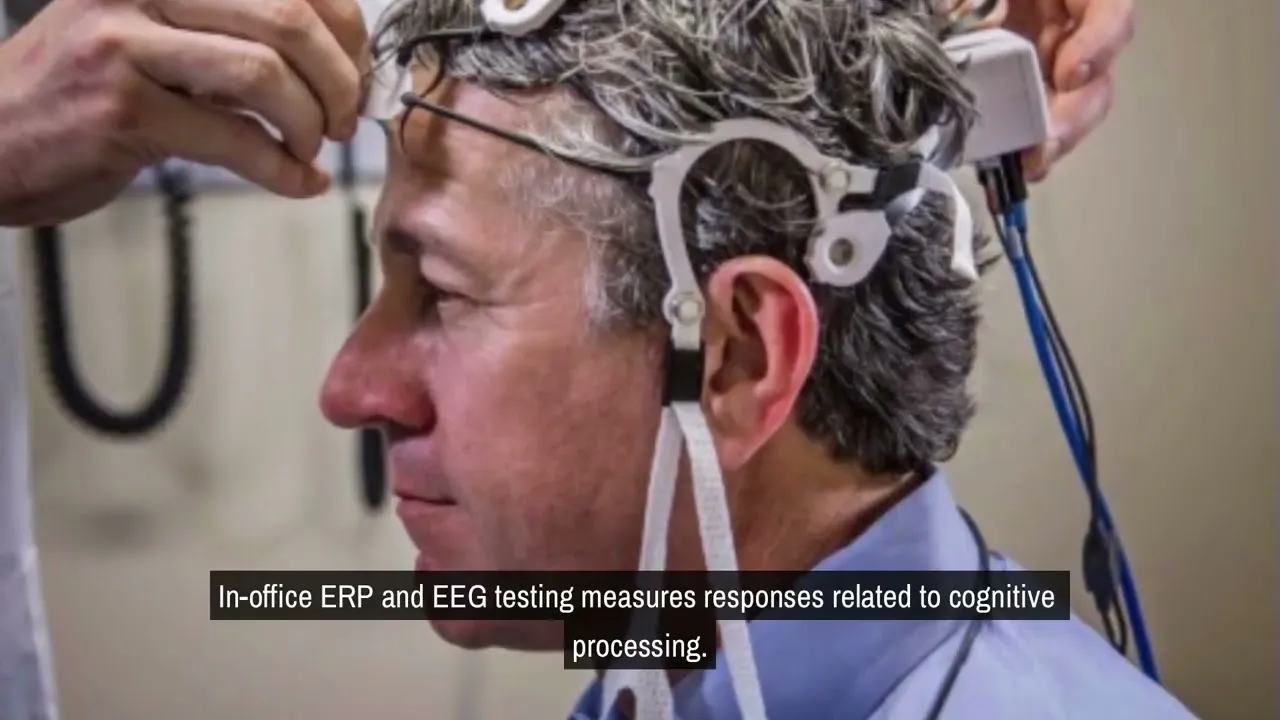
The COGNISION® System provides FDA-cleared ERP and EEG testing designed for in-office use. During testing, the patient wears a headset while auditory stimuli are presented and brain responses are recorded. Resting EEG activity is also collected to provide additional information about background neural function.
The COGNISION® System produces structured reports that can be incorporated into the medical record and reviewed alongside history, cognitive screening, laboratory findings, medication review, and caregiver input.
This allows objective brain-function data to become part of the broader dementia evaluation and care-planning process.
Supporting Decisions When Symptoms Are Subtle
Early dementia symptoms may not be obvious during a brief office visit. A patient may appear conversational and independent while family members report changes in memory, organization, judgment, or daily routines. Screening results may be borderline or inconsistent, leaving uncertainty about how closely the patient should be monitored.
The COGNISION® System can add another layer of information when the clinical picture is still developing. Objective findings may support closer follow-up, additional evaluation, referral, or the establishment of a baseline for future comparison.
This can help providers move forward with greater confidence when symptoms do not yet point to a clear conclusion.
Establishing a Baseline for Ongoing Planning
Dementia care planning is longitudinal. A single evaluation may identify concern, but repeated assessment helps clarify whether cognitive function is stable or declining.
The COGNISION® System allows providers to establish objective baseline data that can be compared with future testing. This creates a measurable reference point as the patient’s condition evolves.
When repeat results remain stable, providers may have greater support for continuing the current monitoring plan. When measurable changes occur, the findings can contribute to decisions about treatment, referral, caregiver involvement, safety planning, and follow-up frequency.
Strengthening Documentation
Clear documentation is essential in dementia care. Providers must often explain why additional evaluation, closer monitoring, specialist referral, or changes in support are clinically appropriate.
Reports from the COGNISION® System provide structured, reproducible data that can strengthen the medical record. These findings can be reviewed over time and shared with neurology, geriatrics, and other members of the care team.
Objective documentation also supports continuity when multiple providers are involved in the patient’s care.
Improving Conversations With Patients and Families
Dementia-related discussions are often difficult, especially when symptoms are early or uncertain. Patients may resist the idea that cognitive changes are occurring, while family members may feel concerned without having clear evidence to support what they are observing.
Objective findings from the COGNISION® System can make these conversations more concrete. Providers can explain that the evaluation includes measurable brain-function data in addition to history and screening.
This can reduce ambiguity, improve understanding, and help patients and families participate more meaningfully in decisions about monitoring, support, and future planning.
Supporting Safety and Functional Planning
As dementia progresses, care planning may involve medication oversight, driving concerns, home safety, financial management, caregiver support, and the patient’s ability to complete daily activities independently.
The COGNISION® System does not determine these decisions on its own. However, objective cognitive data can contribute to the broader clinical assessment that informs them.
When combined with functional history, caregiver observations, and clinical examination, the COGNISION® System can help providers better understand whether cognitive concerns appear stable or are becoming more significant over time.
Helping Coordinate Long-Term Dementia Care
Dementia care often involves multiple providers and caregivers. Objective reports can support communication across the care team by giving everyone access to a consistent source of physiologic information.
This can be especially helpful when patients transition between office-based care, neurology, geriatrics, home health, or other services. Longitudinal findings from the COGNISION® System can provide useful context for treatment planning and follow-up.
A Stronger Foundation for Dementia Care Planning
Effective dementia care planning depends on a complete and evolving understanding of the patient’s cognitive health. The COGNISION® System adds objective ERP and EEG data to that process, helping providers strengthen assessment, establish baselines, monitor change, and document clinical decisions.
By combining physiologic brain-function data with history, screening, and caregiver input, the COGNISION® System supports clearer communication and more informed long-term planning for patients facing cognitive decline.
For more information on the COGNISION® System, call Primary Care Diagnostics at (731) 234-5095 or (423) 914-2986.
Request More Information
Message received
Thank you. We will be in touch soon.
Need immediate assistance? Call us: (731) 234-5095 or (423) 914-2986